

Here is the conversation I have had more times than I can count. A couple tells me they are not having much sex, and when I ask what is getting in the way, nobody says they have stopped loving and wanting each other. They say they’re tired and busy. The week got away from them.
They keep meaning to but real life happens and “it” just doesn’t.
That is not a desire problem. That is a calendar problem, and it has a calendar solution.
But, to be honest, it’s one that most couples resist, because scheduling sex sounds like the least romantic idea anybody has ever had. However, the alternative is waiting for the mood to show up on its own and life to slow down, and for most married couples that just doesn’t happen often.
Stay with me, because scheduling doesn’t have to kill spontaneity. It doesn’t automatically take away the romance. In fact, when done right, it is the opposite.

Leaving It to Chance Is Also a Decision
Tony and Alisa DiLorenzo came on the podcast to talk about this, and their story is the one I hear constantly. They have been married more than twenty years and have scheduled sex for over a decade.
But not at first.
“The first 10, 11 years of our marriage, we’d really just left that to chance,” they told me. “If the mood struck, if the stars were in alignment, if we weren’t exhausted.” And then the honest part: they were hoping it would happen on its own, and it was not happening.
Here is why that is so common. Every picture of sex we absorb from movies and novels involves perfect lighting, nobody knocking on the door, and rose petals from the hallway to the bed. Real life has laundry and a two-year-old. Waiting for the version we were sold means waiting a long time.
Not scheduling is not the romantic choice. It is just an unexamined one, and it hands your sex life to whatever energy is left over after everything else has taken its share.
Schedule Play, or Work Will Take the Whole Calendar
We put vacations on the calendar. Kids’ camps. Dentist appointments. Date nights. Whether we’re looking forward to them or not, we schedule the things we prioritize.
Nobody thinks booking a holiday in March makes the holiday less fun, and nobody has ever said a date night felt like a chore because it was blocked off on the schedule.
The things that go on the calendar are the things that survive. Everything else gets eaten by the things that do. If you never schedule play, work will quietly fill every square, because work always has another thing to ask for and play never insists.
So the question is not really whether to schedule sex. It is whether your marriage gets a claim on your week before the rest of life takes it, or after.
Anticipation Is Romance
This is the part couples miss, and it is the strongest argument for doing it.
Think back to dating. You scheduled those. Friday at seven, and you both knew it days in advance. Did knowing ruin it? It did the opposite. You thought about it on Wednesday. You picked what you were going to wear. You looked forward to it. The anticipation was not a side effect of the date, it was half the date.
Nothing about that changes because you are married. Knowing Saturday is coming gives you all week to flirt, tease, and send the kind of text you would not send if you were not both already thinking about it. If you want help with that part, our 25 sexy text messages to send your spouse are built for exactly this.
And if you have responsive desire, this is not optional
Some people feel desire out of nowhere. Others only feel it once things are already underway, which is called responsive desire and is completely normal.
If that is you, being ambushed at 10pm when you are already in bed and still mentally running tomorrow’s schedule is the worst possible setup. You have had no runway. Knowing it is Saturday gives you the whole day to get there, and that matters enormously if you are someone who needs to shift out of parent mode and employee mode before you can be anywhere near partner mode. Our guide to getting in the mood covers how to use that runway well.
Windows, Not Appointments
When I put the spontaneity objection to Tony directly on episode 37 with Tony and Alisa DiLorenzo, he did not defend scheduling. He redesigned it.
“It’s about looking at the lifestyle that the two of you want to have around sexual intimacy,” he said. Not a time on a clock. A shape for the week.
Then he described how it actually runs in their marriage. “Sunday, Monday, Tuesday are the days that I have the opportunity to initiate,” he said. If it does not happen Sunday or Monday, it happens Tuesday. And his conclusion is the whole point: “So the spontaneity that people want is still there, and we created it this way.”
That is the distinction almost every article on this subject misses. You are not booking a nine-o’clock slot. You are agreeing on a window, and leaving everything inside it open.
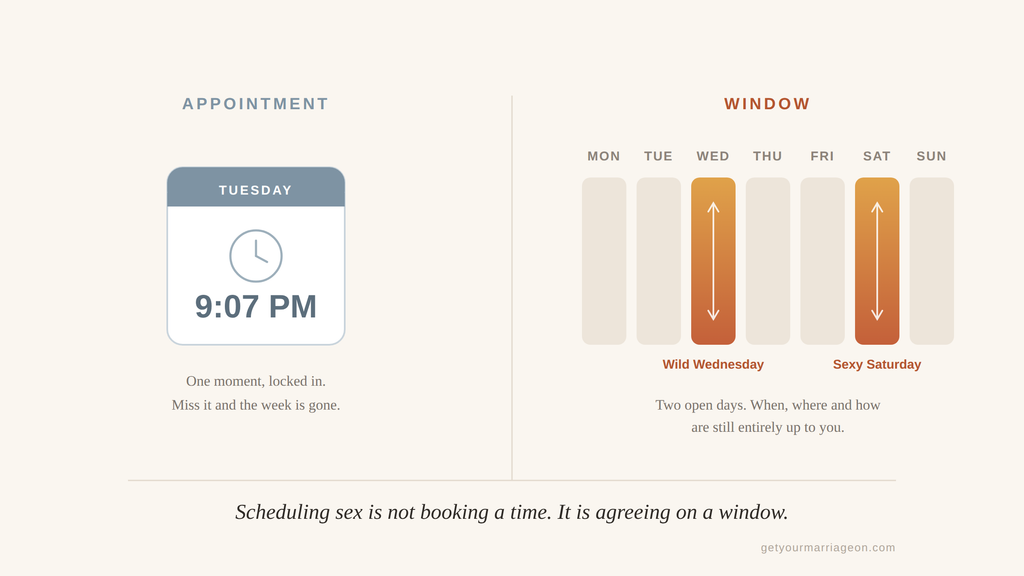
What Is Actually Left to Chance (Almost Everything)
Say you land on Wild Wednesday and Sexy Saturday. She has Wednesday, he has Saturday. Now look at how little you have actually pinned down:
- When. Wednesday could mean before the kids are up, the second they leave for school, or eleven at night.
- Where. Nothing says bedroom.
- How it starts. A text at lunchtime, an outfit, a whisper in the kitchen, or no warning at all.
- What happens. Position, pace, lingerie, lights on or off, whether it is fifteen minutes or the whole evening.
- What they planned. You genuinely do not know, and finding out is the fun part.
You have fixed one variable and left a dozen open. That is not the death of spontaneity. That is a container for it. And having a named day each way solves something else quietly: it stops one spouse being the only one who ever asks, which is its own slow poison. If that dynamic is familiar, our post on initiating without the rejection spiral goes deeper.
What Are You Actually Scheduling?
Here is the objection I take most seriously. Some couples resist this because scheduling turns sex into an obligation, and obligatory sex is the worst kind there is. I completely agree. If putting it on the calendar creates a debt that comes due on Saturday, we have made things worse, not better.
So ask a different question: what are you really scheduling?
Is there a minimum level of physical contact you would generally never say no to? A long kiss. Fifteen minutes of back-scratching with your shirt off. Showering together. Lying down with no clothes on and no particular agenda.
Schedule that. Agree in advance that it does not have to go anywhere, and mean it. What you have put on the calendar is the connection, not a performance you owe. Most of the time it goes further, because starting is the hard part and you removed it. Sometimes it does not (for example, if someone is feeling sick), and that has to be genuinely fine or the whole arrangement curdles into duty sex, which is the thing we were trying to escape.
What It Does for Each of You
In marriages with a desire gap, and that is most marriages, this does two different jobs at once.
The higher-desire spouse stops keeping score. A surprising amount of tension in these marriages is not about frequency, it is about uncertainty. Not knowing when the next time might be turns every interaction into a possible opening, which your spouse can feel, and which makes them want to hide. Tony put it plainly: there is no worrying about whether it is going to happen, because you can count on it. When the answer is on the calendar, the pressure comes out of every other moment in the week.
The lower-desire spouse gets warning. No more bracing. No more reading every affectionate touch as a down payment. You know when it is, you can prepare for it, and you can enjoy the rest of the week without calculating. If desire differences are the live issue in your marriage, start with what to do when you have mismatched sex drives.
How to Start This Week
- Have the conversation outside the bedroom, when neither of you is aroused, tired, or defensive. Sunday afternoon with the calendars open beats midnight in the dark.
- Pick two windows, not two times. Days, not clock times. Name them if you want, because it is harder to skip Wild Wednesday than to skip an unnamed obligation.
- Decide who has which day. One each is the simplest fix for lopsided initiating.
- Agree on the minimum. Write down the thing neither of you would turn down. That is what is actually being scheduled.
- Protect it like a dentist appointment and treat it like a date. You would not casually cancel the first. You would not dread the second.
- Review it in a month. Wrong days, wrong number, wrong minimum, all normal. Adjust rather than abandon.
One more thing worth saying out loud: a schedule is a floor, not a ceiling. Nothing about Wednesday and Saturday forbids Friday afternoon. Most couples find the unplanned times go up rather than down, because a sex life that is actually happening generates its own momentum.
Scheduling Sex: Common Questions
No, because you are scheduling a window rather than a moment. You fix the day and leave everything else open: the time, the place, who starts it, what you wear, and what actually happens. You have fixed one variable and left a dozen to chance, and most couples find unplanned encounters go up rather than down.
It does if you schedule a performance. It does not if you schedule a minimum. Agree together on the smallest level of physical closeness neither of you would turn down, such as a long kiss or lying down together with no clothes on, and put that on the calendar with no requirement that it go further. Most of the time it does, because starting was the hard part.
There is no correct number, and chasing one is how this goes wrong. Start with twice a week if that feels reachable, or once if it does not, and review after a month. What matters is picking something you will actually keep rather than something that sounds impressive.
That is expected, particularly for a spouse with responsive desire, who often does not feel desire until things are already underway. This is exactly why the minimum matters. Start with the thing you agreed you would never say no to and let desire catch up, which it usually does. If it does not, the evening was still time together and nobody failed.
Better to pick the day and leave the time open. A clock time creates pressure and falls apart the moment a child gets sick or a meeting runs late. A day gives you flexibility and preserves the surprise of not knowing exactly when your spouse will make their move.
Raise it outside the bedroom and frame it as protecting something you both value rather than fixing a problem one of you has. Try saying you miss this and you do not want it to keep losing to everything else in the week. That is a very different conversation from saying we are not having enough sex.
Where to Go Next
Listen
- Episode 37: Scheduling Sex with Tony and Alisa DiLorenzo. The full conversation this post draws on. Their 60-day challenge, how the windows system works in practice, and what they call the intimacy lifestyle.
- Episode 82: Q&A About Sex and Intimacy. Includes the question of whether you really need it on the calendar, and the dating comparison.
Read
- Sexual Desire in Marriage: The Complete Guide. The bigger picture this sits inside.
- Responsive Desire. Why you may not want sex until you have started.
- Why Don’t I Want Sex Anymore? If the problem is desire itself rather than the calendar.
- 9 Different Types of Sex in Marriage. Useful for deciding what a given window is actually for.
- Sex After Baby. Scheduling matters most in the season when it is hardest.
- How to Spice Up Your Sex Life. For filling the windows once you have them.
Want help making it happen? Our Intimately Us app has a private intimacy calendar, plus prompts and games for the evenings you have set aside.
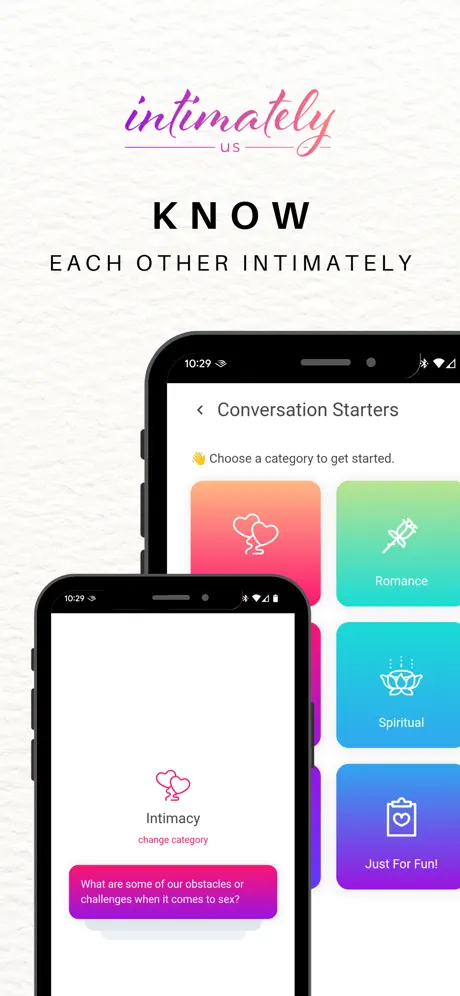
Try this fun & sexy app for your marriage!
Bring back flirty fun, connection, and creativity—without anything crass. Sync with your spouse, play bedroom games, explore new ideas, and deepen intimacy.
Learn more →I love this app! My husband and I are such busy people—this helps us stop and show the love we have for each other. I’d give 6 stars if I could!
This is by far the #1 sex app for Christian couples! We played the games five times last week. Sparks are flying and we’ve never felt so close.