

If you are searching for how to last longer in bed with your wife, I want to start somewhere other than technique. A husband wrote to me recently, and if you are reading this, you have probably thought something close to his words.
“I am embarrassed to admit that I cannot last very long. I think my wife is smoking hot, but as soon as things get going, I can only last about 60 to 90 seconds. She is really kind but I sense she is unsatisfied. Sex does not happen very often lately, and I think part of it is because I am embarrassed.”
My honest hunch, and I say this to almost every man who asks: the anxiety you feel about lasting longer is almost certainly making it worse. When you are in your head monitoring yourself, bracing for the moment it ends, you are not actually present with your wife. You are managing a performance. That tension tends to speed everything up rather than slow it down, and it becomes a self-fulfilling cycle.
So before any technique, I want to deal with the mental side, because I think that is where the real work is.
Is This Actually Premature Ejaculation?
It helps to know where the clinical line sits, if only so you can stop guessing.
The International Society for Sexual Medicine defines lifelong premature ejaculation as ejaculation that always or nearly always happens within about one minute of penetration, going back to the first sexual experience. Acquired premature ejaculation is a clinically significant drop from your own previous normal, often to around three minutes or less. Both also require an inability to delay on nearly all occasions, and negative personal consequences such as distress, frustration, or avoiding sex.
Read that last criterion again, because it is the one people skip. Distress is part of the definition. If your timing does not bother either of you, there is no problem to solve, whatever a number says. And if it does bother you, that distress is a legitimate reason to work on it even if you are technically outside the thresholds. You can read the clinical overview of premature ejaculation if you want the full picture.

The Anxiety Loop Is Doing Most of the Work
Here is what I see happen. A man finishes faster than he wanted to. He feels embarrassed. Next time, he is watching the clock in his head from the first minute, monitoring his own arousal, trying to hold something back.
That monitoring is itself arousing in the worst way. It is hypervigilance, and hypervigilance is a high-adrenaline state. You are not relaxed, you are not present, and you are certainly not enjoying your wife. You are running a stopwatch.
The more he tries to control it, the faster it goes. The faster it goes, the more he dreads next time. I have watched that loop tighten in a lot of marriages, and for most men the way to last longer in bed starts with breaking that loop rather than with a better technique.
7 Things That Actually Help You Last Longer With Your Wife
1. Change what counts as sex
This is the biggest one, and most men skip straight past it looking for a technique.
Most women do not reach orgasm through penetration alone. The research on that is pretty clear. So if your wife’s satisfaction depends entirely on how long intercourse lasts, the two of you are working from a framework that was never going to serve either of you. Expanding what sex means, with more touch, more oral, more manual, more teasing before and after penetration, can completely change her experience without you performing differently at all.
Our guides to helping your wife reach orgasm and the erogenous zones most couples overlook are both more useful here than anything about timing.
2. Breathe, and let your pelvic floor go
A lot of men tense up hard right before ejaculation, particularly through the pelvic floor. Learning to stay loose and keep breathing slowly through high arousal genuinely buys you time. Long exhales. Shoulders down. Jaw unclenched.
3. Get out of your head and into your body
This sounds like the opposite of control, and it is, which is the point. Put your attention on what you can actually feel: her skin, her breathing, the temperature of the room. Attention on sensation slows things down. Attention on performance speeds them up.
4. Consider that some of this may just be how you are built
Research hints that some men are genetically predisposed to ejaculating more quickly than others. If that is you, learning to work with your circumstances rather than fighting them may be the healthier path. Not everything is a problem to be fixed. Some things are a shape to be built around.
5. Use a condom or a delay spray as breathing room
Delay sprays temporarily reduce sensitivity, and a condom does something similar. Neither is a fix and I would not want either to become a crutch, but both can give you a little space while you work on the part that actually matters.
6. Take the timer off entirely
I mean this practically, not as a comforting phrase. Decide together, out loud, that the length of intercourse is not the measure of the evening. When that stops being the scoreboard, most of the anxiety has nothing left to attach to, and men frequently find they last longer in bed once they have stopped trying to.
7. Have the actual conversation
The fact that sex is happening less often is the real concern in the letter above. Embarrassment leads to avoidance, avoidance leads to distance, and that pattern will quietly erode a marriage faster than any timing issue.

Have it outside the bedroom, in a calm moment, not in the middle of things. Something like:
“I have been feeling embarrassed about finishing quickly, and I think it has got in the way of us being close. I want to work on it with you.”
That kind of honesty, what I would call genuine self-exposure, tends to bring couples closer and take pressure off both people at once. If talking about sex is hard for the two of you generally, start with our guide to sexual communication in marriage.
The One Technique Everybody Recommends That I Am Not Sold On
The stop-start method is the standard advice. During sex, when you feel yourself getting close, you stop, let arousal drop, then continue, training your body to tolerate higher arousal without tipping over.
It does work for some men, and I am not going to tell you to ignore it. But it is not my favorite, and here is why: it puts you right back in your head. You end up monitoring whether you are close and whether you need to stop, which is precisely the hypervigilance that caused the problem. You have swapped one form of self-surveillance for another.
If you want to practice arousal control, I would rather you do it on your own first, where there is no performance pressure, and then bring a relaxed body to your wife rather than a monitoring one. Our page on edging and delaying orgasm covers that practice properly, and multiple male orgasms goes further for men who want to.
If You Are the Wife Reading This
A few things that help more than you might think.
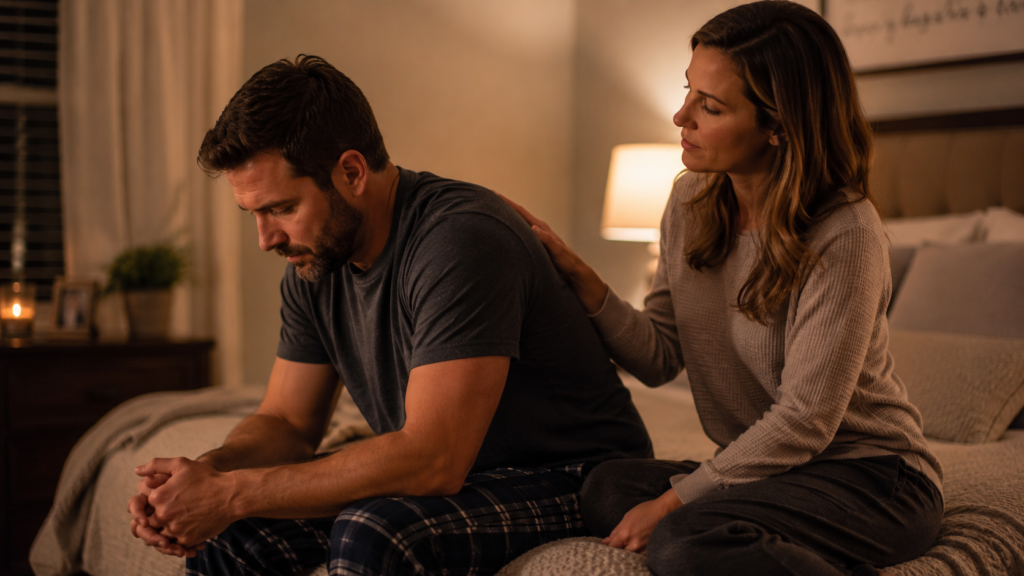
- Say the timing does not bother you, if it does not. He may be carrying more shame about this than he has ever said out loud, and he will not believe it is fine unless you tell him.
- Ask for what you want directly. If what you actually want is longer foreplay rather than longer intercourse, say so. He may be solving the wrong problem with enormous effort.
- Do not let it become the unspoken thing. Avoidance is the real risk here, and it usually grows in silence rather than in conversation.
When to See a Doctor
Most of this is not a medical problem. But it is worth a conversation with a doctor if:
- The change was sudden, particularly if it came alongside a new medication or a health change.
- It happens with pain, blood in the semen or urine, or difficulty urinating.
- You also have trouble getting or keeping an erection, since the two often travel together and treating one can help the other.
- The distress is significant and persistent. Prescription options exist and a doctor can talk you through them.
There is no shame in raising it. Urologists and sex therapists have this conversation constantly.
The Bottom Line
The goal of sex is not a number of minutes. I know that sounds like something people say to make you feel better, and I mean it practically instead. The couples who work out how to last longer in bed almost never do it by finding a technique. They do it by changing what they are measuring, and by talking about it once, honestly, outside the bedroom.
Lasting Longer: Common Questions
The International Society for Sexual Medicine defines lifelong premature ejaculation as ejaculation within about one minute of penetration going back to the first sexual experience, and acquired premature ejaculation as a significant drop from your own previous normal, often to around three minutes or less. Both also require an inability to delay and real personal distress.
The most effective changes are not techniques. Expand what counts as sex so intercourse length stops being the measure, breathe slowly and keep your pelvic floor relaxed, put your attention on sensation rather than on monitoring yourself, and take the timer off entirely. Condoms and delay sprays can buy breathing room while you work on the rest.
Almost always. Monitoring yourself during sex is a high-adrenaline state, and it tends to speed things up rather than slow them down. The more a man tries to control it, the faster it usually goes, which is why the way out is rarely a better technique.
It works for some men. My reservation is that it puts you back into monitoring whether you are close and whether you need to stop, which is the same hypervigilance that causes the problem. If you want to practice arousal control, doing it on your own first, without performance pressure, avoids that trap.
Research suggests some men are genetically predisposed to ejaculating more quickly. If that is the case, adapting to how you are built is often healthier than fighting it. Not every difference is a dysfunction.
Yes, outside the bedroom and in a calm moment rather than during sex. Something like: I have been feeling embarrassed about finishing quickly and I think it has got in the way of us being close, and I want to work on it with you. Embarrassment leads to avoidance, and avoidance does far more damage to a marriage than timing does.
Want help building the kind of sex life where the clock stops mattering? The Intimately Us app is full of ideas for exploring together.