


Yes — men can have multiple orgasms, but it takes practice. The key is separating orgasm from ejaculation: ejaculation triggers the refractory period (the “cool-down” that ends arousal), while orgasm itself does not. By learning to recognize arousal levels and ease off just before the point of no return, a man can experience repeated orgasms without ejaculating.
Men are pretty good at having orgasms. A large 2018 study showed that heterosexual men experience an orgasm more than 95% of the time they have sex. Those are great odds when compared to how often heterosexual women experience orgasms (65%). However, when it comes to having multiple orgasms during sex, men don’t have the same advantage.
Women don’t experience a refractory period, a length of time when the body doesn’t respond to direct sexual stimulation, allowing them to keep riding the waves of pleasure as long as they have the energy to do so!
When you think of a male orgasm you often think of ejaculation. Male bodies definitely do ejaculate as a response to an orgasm, however with practice, patience, and determination, men can prolong the pleasure they feel by resisting ejaculation.
In this post I’ll show you that orgasm and ejaculation are actually two separate processes, how ejaculation is responsible for the start of the refractory period, and offer practical tips to learn how to enjoy multiple orgasms without ejaculating.

Orgasm vs. Ejaculation: What’s the Difference?

Ejaculation and orgasm are two separate physiological processes that are sometimes difficult to distinguish. Orgasm is the peak of intense pleasure that often creates an altered state of consciousness. Ejaculation is when a man’s body expels semen.
With little exception, after a man ejaculates, his body relaxes and returns to a pre-aroused state. He’s unable to gain an erection or have an orgasm during this time. This return to rest is called a refractory period. Depending on a man’s age and health, a refractory period can be as short as 15 minutes, a whole day, or longer.
If you can learn to enjoy an orgasm and resist ejaculation, you can avoid the limitations that a refractory period places on your body’s ability to continue feeling sexual pleasure.
Arousal Awareness: Finding Your Point of No Return
Arousal awareness is the first step to enjoying the pleasure of a small orgasm without ejaculating.
Our body follows a predictable pattern from arousal to orgasm. Every person has an arousal threshold and an orgasm threshold. As you begin sex, your arousal builds to a point and usually plateaus for a period of time (the excitement phase). After a sufficient amount of stimulation, your arousal level leaves the plateau and rises quickly towards your orgasm threshold.
For men, just after the peak of the orgasm threshold is the point of no return (also called ejaculatory inevitability). Once you hit this point in your arousal, there’s very little you can do to stop yourself from ejaculating.
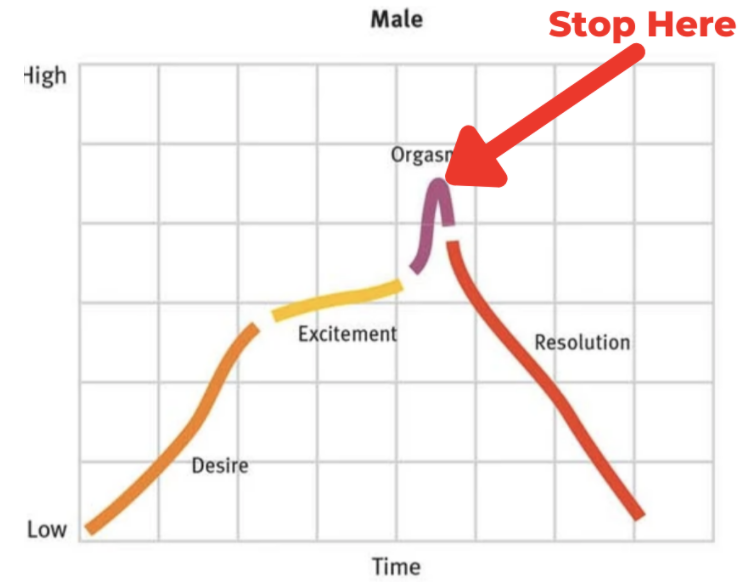
The key to enjoying multiple orgasms is to get skilled at identifying the point in your arousal immediately prior to reaching the point of no return.
An arousal scale is a great way to start becoming aware of your arousal pattern. You can determine what points are on your individual arousal scale but let’s say a completely flaccid penis is a zero, a penis begins to get erect at a 3, feeling highly aroused is a 7, and the moment of ejaculatory inevitability is a 10.
How to Practice Multiple Male Orgasms
Next time you have sex, focus on your arousal pattern and determine when you hit the different points on your arousal scale. Practice “cooling down” by lowering your arousal level by using some of the strategies suggested below. For instance, you could practice going from a 5 (stimulated but not highly aroused) to a 7 (feeling highly aroused), then back down to a 5. Or move from a 7 to a 9 and then back to a 7. Learning how to “cool” your own arousal helps prolong your pleasure.
It’s perfectly normal to have times where you cross your ejaculation threshold and experience a full ejaculatory orgasm when attempting to learn how to better control your arousal. Go easy on yourself and try again another time.
Give yourself a realistic runway. This is a skill, not a switch — most men don’t get it on the first attempt, or the fifth. Some find it clicks after a few weeks of consistent practice; for others it takes longer. The bigger win is often the body awareness and self-control the practice builds, which changes the whole experience for both of you.
You can do these exercises with your wife or alone through healthy masturbation. However you decide to do the exercises, it’s best to talk to your wife first about your goals and intentions. A conversation may go something like, “I’d like to learn to have more self control over my arousal. I’d like to work through some exercises so that the sex we share is more pleasurable for the both of us. Would you like to work with me on this?”
It’s always sexy when you and your spouse can work together as an intimate team to improve your sex life together!
The Please, Squeeze, Ease Technique

The easiest way to accomplish separating orgasm from ejaculation is the “please, squeeze, and ease” technique. This works by taking advantage of the body’s natural physiological response.
The first step is to get aroused (the “please”) near the point of ejaculatory inevitability. Using the scale example from the previous section, you want to get to about a 9.5 on the arousal scale.
Right before ejaculation, you’ll want to squeeze the tip of your penis. Your body naturally releases some blood from the penis prior to ejaculation anyway, so take advantage of this physiology at work by squeezing (or have your wife squeeze) the glans (the soft tip) of your penis with your index finger and thumb. This pushes a little more blood out of the penis, reducing the urge to ejaculate and temporarily cools down your arousal.
Once the urge to ejaculate has passed, “ease” back into stimulation to build up your arousal level again. If you can interact with the peak of orgasmic pleasure without release, you can ride the pleasure of the moment and enjoy getting highly aroused again.
The Kegel Squeeze Method
Pulling out to squeeze the tip of your penis may not be very romantic. Another method for delaying ejaculation at the height of arousal is to squeeze your pelvic floor muscles, like doing a Kegel exercise. You may be familiar with Kegel exercises. If you can stop the flow of urine while going to the bathroom, you’re squeezing your pelvic floor muscles the right way. (You can learn more about Kegel exercise on the Intimately Us app!)
Timing is important. You’ll want to squeeze a moment before you usually feel the urge to ejaculate. Flexing your PC muscles as hard as you can puts pressure on your prostate. Squeezing in this way controls the ejaculation contractions that usually follow an orgasm.
The Million Dollar Spot (Perineum Pressure)
Similar to squeezing your prostate, you can apply pressure to your prostate at the right moment to slow your arousal. The “million dollar spot” is located on your perineum (the soft part of your body between your scrotum and your anus). It’s a soft indentation anterior (in front of) your anal canal. Pushing hard into this area may also feel quite pleasurable when at the peak of arousal.
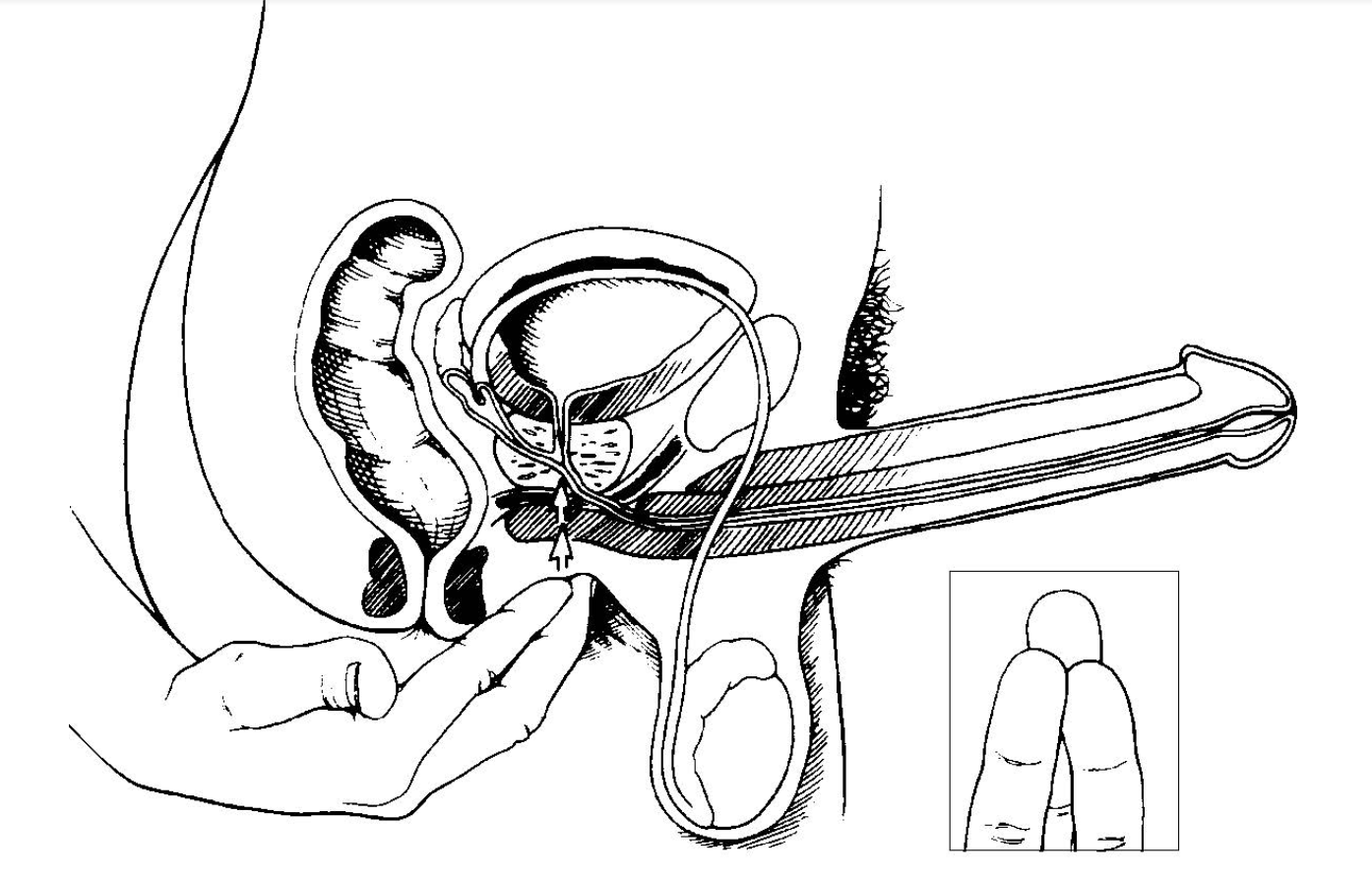
Scrotum Tug
As a man gets aroused, his testicles draw up closer to his body. You can tug on the bottom of your scrotum or push down gently on your testicles from the base of your penis away from you to move them back down. This aids in cooling down your arousal to prolong your pleasure.
Relaxation and Breathing Techniques
Men have used relaxation exercises successfully to gain control over their arousal at the peak of pleasure.
For this technique, focus on your breathing as you get aroused. Take deliberate, deep, slower breaths to calm the body down as arousal builds. When you get close to the point of ejaculatory inevitability (a 10 on the arousal scale), your body will naturally want to tense your pelvic floor. You’ll instead consciously relax the pelvic floor muscles and stop all penis stimulation to relax and enjoy the sensation. Some men report that keeping their eyes open during this time also helps them relax their body.
It’s common for men to experience one or two pleasurable contractions and lose a little bit of their erection. Don’t let this scare you! Without a full ejaculation (and refractory period), you can get aroused again and enjoy more sexual pleasure.
Edging vs. Multiple Male Orgasms

Whether or not the above techniques are simply edging techniques or bona-fide multiple orgasms for men is still not well understood and debated. Either way, being able to prolong the peaks of pleasure from sexual connection with your wife is a great idea. Learning your arousal pattern and practicing delayed gratification is a great skill to gain. Self-control is super sexy too!
To read more on these topics, here are some books we recommend! (These are Amazon affiliate links — if you buy through them we may earn a small commission, at no extra cost to you.)
Or check out our new course 6 Weeks to Multiple Male Orgasms!

If you liked this how-to, there’s more waiting in the Intimately Us app, including a full guide to Kegel exercises. You may also want to hear Dan talk this through in episode 113, or read our guide to the frenulum orgasm — the most nerve-rich spot on the penis, and a natural next step in learning your own arousal.
Wondering how all of this fits within a faith-filled marriage? See our pillar on sex and faith in marriage.
Multiple Male Orgasms: Common Questions
Yes, though it takes practice. Orgasm and ejaculation are two separate physiological processes. The refractory period that ends arousal is triggered by ejaculation, not by orgasm, so a man who learns to experience orgasm without ejaculating can keep going.
Learn your arousal scale, then ease off just before the point of no return. Rate your arousal from zero to ten, where ten is ejaculatory inevitability, and practice climbing to about nine and coming back down. The squeeze technique, a hard pelvic floor contraction, perineum pressure and slow breathing are all ways to cool down at the right moment.
By building awareness of exactly where you are on your arousal scale and intervening a moment before the urge to ejaculate arrives. Timing is everything. Squeezing the glans, flexing your pelvic floor hard, pressing the perineum, or deliberately slowing your breathing all interrupt the ejaculation reflex while leaving the orgasmic pleasure intact.
It is the recovery window after ejaculation when the body will not respond to sexual stimulation and an erection is difficult or impossible. Depending on age and health it can last fifteen minutes, a full day, or longer. It is triggered by ejaculation rather than by orgasm itself.
This is a skill rather than a switch, and most men do not manage it on the first attempt or the fifth. Some find it clicks after a few weeks of consistent practice, while for others it takes considerably longer. Early attempts that end in ejaculation are a normal part of learning.
Yes. Learning greater awareness and self-control over your own body is not indulgence, and pleasure within marriage is good and God-designed. Most husbands find the real benefit is being more present with their wife and less focused on racing to the finish, which serves the marriage rather than just the moment.
Written by Amanda Severson, a Licensed Marriage and Family Therapist (LMFT), with Get Your Marriage On!
Try this fun & sexy app for your marriage!
Bring back flirty fun, connection, and creativity—without anything crass. Sync with your spouse, play bedroom games, explore new ideas, and deepen intimacy.
Learn more →I love this app! My husband and I are such busy people—this helps us stop and show the love we have for each other. I’d give 6 stars if I could!
This is by far the #1 sex app for Christian couples! We played the games five times last week. Sparks are flying and we’ve never felt so close.