

If you are newly married and searching for sex positions, there is a good chance you are really asking something underneath it: are we doing this right?
So let’s take the pressure off at the start. The first year of marriage is not a performance you can fail. Most couples in their first year are not held back by a shortage of positions. They are held back by nerves, by not knowing how to say what they want, and by expecting the whole thing to arrive fully formed. Positions are genuinely useful, but they are useful the way good shoes are useful on a hike. They remove obstacles. They are not the hike.
Below are seven positions worth starting with as a newlywed couple, chosen for reasons that matter early on rather than for how impressive they look. Then, further down, the part almost nobody tells you before the wedding night: the practical, slightly unglamorous stuff that spares a lot of couples a lot of confusion.

What Actually Makes a Position Good for Newlyweds
When you are still learning each other’s bodies, three things matter far more than variety:
- You can see each other. Eye contact and a clear view of your spouse’s face is the fastest feedback there is. Early on, when neither of you has the vocabulary yet, faces do a lot of the talking.
- You can adjust without stopping. Positions that require choreography are hard to fine-tune. Ones where a small shift changes the angle let you find what works by feel.
- Either of you can control the pace. Handing control back and forth is one of the quickest ways to learn what each of you actually likes.
Almost everything on this list is on it because it does at least two of those three well.
7 Sex Positions for Newlyweds
1. Missionary, with a pillow
Start with the obvious one, because the obvious one works. Slide a pillow under the wife’s hips and the angle of penetration changes noticeably, often enough on its own to make a real difference. You get full eye contact, easy kissing, and both of you can talk without contortion. It is the position with the lowest learning curve and the highest amount of face-to-face contact, which is exactly what a first year needs.

2. The Coital Alignment Technique (missionary, shifted up)
A small variation with a formal-sounding name. The husband shifts his body slightly further up so that the base of his penis presses against his wife’s clitoris, and the movement becomes more of a rocking motion than thrusting. Fewer than a third of women reach orgasm from penetration alone, so a position that builds in clitoral contact is doing real work rather than just adding novelty. If orgasm is proving elusive, our guide to helping your wife reach orgasm goes much deeper than we can here.

3. Side-lying (scissors)
Both of you on your sides, facing each other, her top leg draped over his. This is the gentlest position on the list. There is very little weight on either person, nobody has to hold themselves up, and it works even without a strong erection, which matters more than newlyweds expect, because nerves and erections have a complicated relationship. It is also the easiest position to simply stop and talk in without anything feeling like it fell apart.

4. Wife on top
She sets the depth, the angle and the pace, all three. For a couple still figuring out what works, that is enormously useful information, and it can be gathered without anybody having to describe anything out loud. Many wives also find they can grind against their husband’s pubic bone in this position, which adds the clitoral stimulation that penetration alone usually misses. A practical note that is rarely mentioned: this position tends to be less stimulating for him, which makes it useful if he is finishing sooner than either of you would like.

5. Seated, facing each other
Husband sits in a chair without arms, or cross-legged on the bed; wife sits facing him in his lap. There is not much thrusting available, which is precisely the point. This is a position built for closeness rather than intensity. You are chest to chest, eye to eye, able to kiss the entire time. Couples who feel like sex is over too quickly often find that this one slows everything down without anyone having to try.

6. Edge of the bed
She lies on her back near the edge of the bed; he stands or kneels on the floor. This solves a problem a surprising number of newlyweds run into quietly, which is that couples are not always built to the same height. Standing lets him adjust his position by inches until the angle is comfortable for both of you, and it takes his body weight off her entirely.
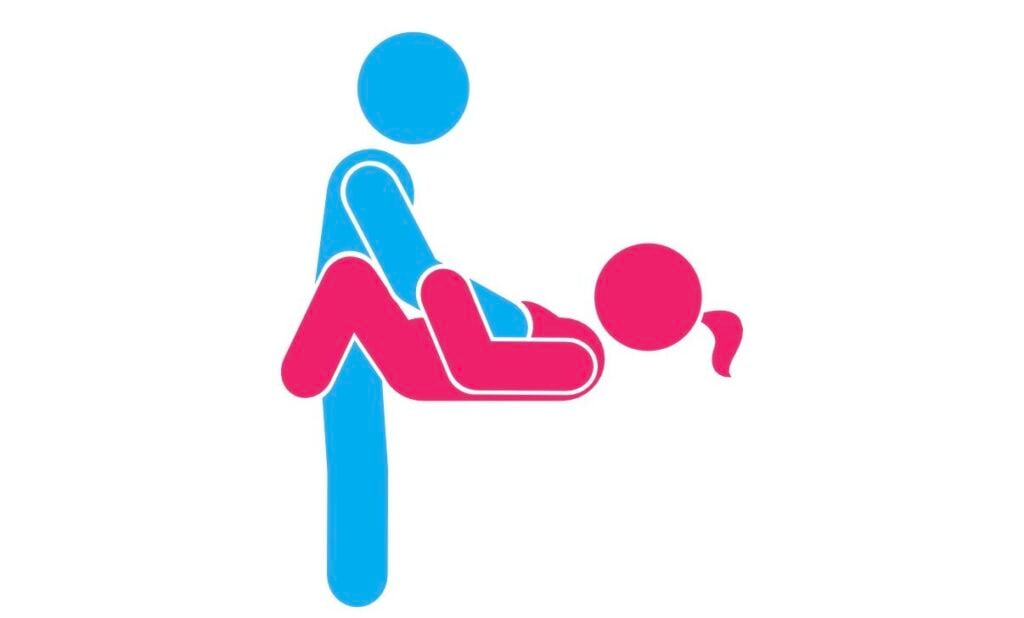
7. Oral and manual: yes, it counts
This is on a list of positions on purpose. A great many first-year couples treat intercourse as the real thing and everything else as a warm-up, and it quietly costs them. Oral and manual stimulation are often where a wife has her first orgasm with her husband, and there is no rule anywhere that says an encounter has to end a particular way to have counted. If you want somewhere to start, our guides to oral sex for women and the different types of sex in marriage both go further.

What Nobody Tells You About the First Year
I have been answering these questions for years on the podcast, and the same handful come up every single time. In episode 238 I got blunt about the practical side of a first sexual experience, so here is the short version.
It is messier than you expect
Nobody warns anybody about this. Put a towel on the bed first. That is the entire solution, and it removes a genuinely awkward moment from an evening that already has enough going on.
Use lubricant from the very first time
Friction does not feel good. Any drugstore sells personal lubricant, and there are good products made from simple, edible ingredients. This is not a sign that something is wrong or that anybody is insufficiently aroused; it is a sign that you read ahead. Arousal and natural lubrication do not always arrive on the same schedule, especially when nerves are involved.
The first time may be over in about two minutes
If it is a husband’s first sexual experience and his body has been anticipating it for years, he will very likely ejaculate quickly. This is normal and it is temporary. Knowing it in advance turns a moment that could feel like a failure into a moment you were both expecting, which is a much better start.
Awkwardness is not a sign that something is wrong
It never entirely goes away, and it is not supposed to. What grows is your ability to handle it: to laugh, keep going, and not treat a fumble as a verdict on your marriage. I talked about this in episode 126. My daughter was in a youth production of The Music Man, and there was a big difference between opening night and closing night. On opening night they were nervous and stumbled over lines, and you could see it drain the energy off the stage. By closing night there were still stumbles. You just could not tell, because of the enthusiasm they were having with it. Sex works the same way. Energy and enjoyment cover a multitude of stumbles.
Trying something does not mean you have to like it
Give yourselves the grace to try a position, decide it is not for you, and move on without either of you taking it personally. A position that does not work is information, not a failure. You will never find out which ones you love without a few that you do not.
If Sex Hurts, Do Not Push Through It
This is the most important paragraph on this page.
Some discomfort the first few times is common. Ongoing pain is not, and it is not something to quietly endure. I have told the story on the podcast of a bride who went into her wedding night expecting it to hurt, found that it did, and grinned and bore it. She was still doing exactly that five years later, by which point sex had become something she managed rather than something she enjoyed. That pattern does not begin with a big decision. It begins with one night of hiding discomfort so as not to disappoint someone.
If sex is painful, say so in the moment, stop, and use lubricant and much slower pacing next time. If it keeps hurting, see a doctor or a pelvic floor physical therapist. Conditions like vaginismus are common, treatable, and have nothing to do with wanting your husband. And if the pattern has already set in, our guide to moving on from duty sex was written for exactly this.
Positions Are the Easy Part
You can learn a position in an evening. Learning to say “a little to the left,” or “that felt amazing, do that again,” or “can we stop for a second?” without either of you flinching. That is the skill that makes the next fifty years good. The couples who thrive are not the ones who tried the most positions in year one. They are the ones who got comfortable talking, early, while the stakes were still low.
If that part feels harder than the physical part, start with our pillar on sexual communication in marriage. And when you are ready to widen the range, our full guide to sex positions for married couples organizes them by what each one is actually for.
Sex Positions for Newlyweds: Common Questions
The ones that let you see each other, adjust without stopping, and hand control back and forth. Missionary with a pillow under the hips, side-lying, wife on top, and seated face to face all do this well. Early on, positions that make communication easy are worth more than positions that look impressive.
Keep it simple. Missionary or side-lying are the two most forgiving, because neither requires much coordination and both let you stop, talk and start again easily. The wedding night is not the time to attempt anything complicated.
Some discomfort is common, but real pain is not something to push through. Use plenty of lubricant, go far slower than you think you need to, and speak up straight away if it hurts. If pain continues past the first few times, see a doctor or a pelvic floor physical therapist. Conditions like vaginismus are common and treatable.
Often only a minute or two, particularly if it is the husband’s first sexual experience. His body has been anticipating it for a long time. This is normal, it is temporary, and knowing it in advance takes most of the sting out of it.
Yes, and using it from the very first time is a good idea. Friction does not feel good, and arousal and natural lubrication do not always arrive on the same schedule, especially when nerves are involved. Needing lubricant is not a sign that anything is wrong.
Completely. Awkwardness never entirely disappears; what grows is your ability to laugh and keep going. Couples who do well are not the ones who avoid awkward moments, but the ones who stop treating them as evidence that something is broken.
Want a whole library of ideas to explore together as you learn each other? The Intimately Us app has conversation starters, bedroom games and over 100 positions, built for married couples.